
ECU Backup and File Management Guide Before Programming
Modern ECU programming requires accurate data handling before any modification or writing operation. A successful ECU programming process does not only depend on the programming tool, but also on how technicians identify, save, verify, and manage original ECU files.
Before performing ECU Read or Write operations, professional workshops usually follow a structured backup workflow to protect the original data and provide a recovery option if unexpected communication problems occur.
This guide explains the essential ECU backup and file management procedures used during professional ECU programming.
Why ECU Backup Is Important Before Programming
The original ECU file contains important calibration data, configuration information, and software parameters from the vehicle manufacturer. Creating a complete backup before programming allows technicians to restore the ECU when necessary.
| Backup Purpose | Technical Benefit |
|---|---|
| Save original ECU data | Provides recovery source before modification or writing |
| Compare modified files | Helps verify changes between original and edited calibration files |
| Prevent data loss | Reduces risk caused by communication interruption or incorrect files |
| Maintain customer records | Allows future service tracking and troubleshooting |
Professional ECU Backup Workflow
A reliable ECU programming workflow normally includes four main stages:
| Step | Operation | Description |
|---|---|---|
| 1 | ECU Identification | Confirm vehicle information, ECU model, hardware number and software version. |
| 2 | Original File Reading | Read ECU data using the correct programming method and save the original file. |
| 3 | File Verification | Check file integrity before any modification or writing process. |
| 4 | Secure Storage | Create a backup archive with clear naming and vehicle information. |
ECU Identification Before Reading Data
The first step in ECU programming is always correct identification. Different vehicles may use different ECU versions even when they share the same model name.
Technicians should record the following information:
- Vehicle manufacturer and model
- Engine type
- ECU manufacturer
- Hardware number
- Software number
- Processor information when required
Checking ECU compatibility before operation helps technicians select the correct programming procedure. The official KT200II supported ECU database provides compatibility information for supported vehicles and ECU types.
View KT200II Supported ECU List
Choosing the Correct ECU Programming Method
Different ECUs require different communication methods depending on their internal architecture. Professional ECU programmers may support multiple connection methods including OBD, Bench, Boot, and JTAG.
| Programming Mode | Main Application |
|---|---|
| OBD | Programming through vehicle diagnostic connector without ECU removal |
| Bench | Direct ECU connection outside the vehicle |
| Boot | Low-level ECU access for specific controllers and recovery operations |
| JTAG | Processor-level communication for supported ECU families |
Selecting the correct operation mode according to ECU information helps improve programming stability.
Learn more about KT200II ECU Programming Modes
Best Practices for ECU File Management
Professional technicians should maintain a clear file management system. Poor file organization can create problems when multiple vehicles or ECU versions are processed.
| File Management Practice | Recommendation |
|---|---|
| File Naming | Include vehicle model, ECU type and date information |
| Original File Storage | Keep untouched backup files separately |
| Modified File Control | Save edited files with clear version numbers |
| Customer Records | Maintain programming history for future service |
Common ECU Programming Backup Mistakes
Skipping Original File Backup
Writing a modified file without saving the original ECU data creates unnecessary recovery risks.
Using Incorrect ECU Files
Files from different hardware or software versions may not be compatible. Always verify ECU information before programming.
Ignoring Software Updates
Updated software resources can provide improved protocol support and compatibility information.
Official KT200II software resources provide technicians with updated programming tools and related support information.
Access KT200II Software Resources
KT200II Professional ECU Programming Resources
For technicians working with ECU reading, writing, backup and recovery operations, using a professional programming platform with accurate compatibility information is essential.
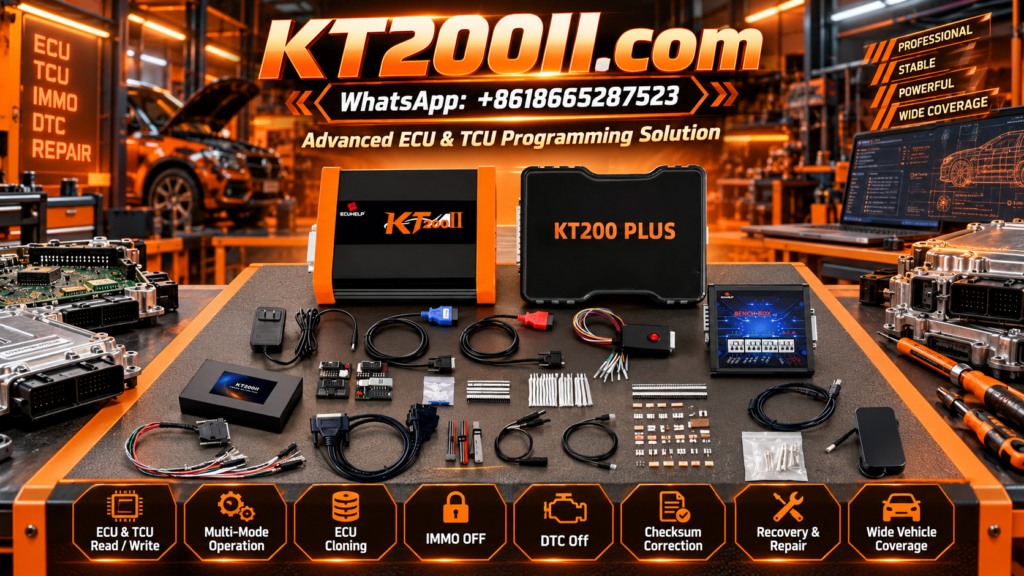
KT200II provides ECU programming support, multiple operation modes, software resources and technical information designed for professional automotive workshops.
Learn More About KT200II ECU Programmer
Additional technical articles and ECU programming guides are available through the official KT200II blog.
Conclusion
ECU programming success depends not only on the programming tool but also on correct preparation and file management. Creating a complete backup, verifying ECU information, selecting the correct programming method, and maintaining organized files are essential steps for professional technicians.
A reliable workflow helps reduce programming risks and improves efficiency during ECU service operations.