
KT200II TCU Programming Guide: Identify the Transmission Before Read or Write
Professional TCU programming begins with exact identification. A transmission name such as DSG, DCT, CVT or 8HP describes a system category, but it does not automatically identify the controller hardware, software, processor, memory layout or supported programming method.
This guide explains how to identify a transmission control unit, search the official KT200II database, select the supported connection mode and verify original data before performing a TCU Read or Write operation.
What Is TCU Programming?
A transmission control unit, commonly called a TCU or TCM, manages electronic transmission functions. Depending on the design, its software may control gear selection, clutch operation, hydraulic pressure, torque coordination, shift timing and communication with other vehicle modules.
TCU programming refers to supported operations involving controller data. These may include identification, reading, writing, backing up or service-related programming. Available functions depend on the exact transmission controller and protocol listed by the programming tool.
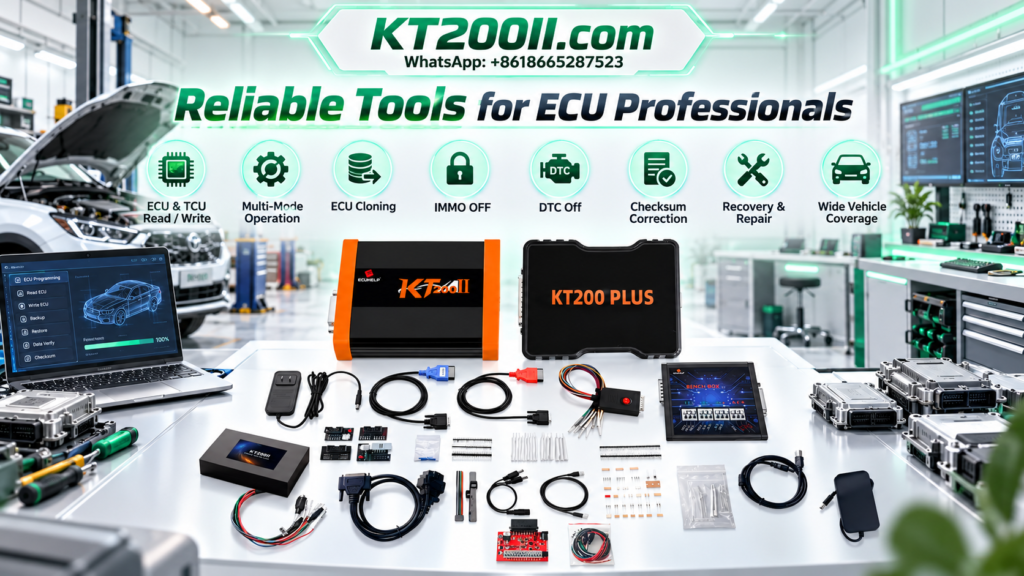
KT200II.COM is the official KT200II website for product information, software, operation modes, supported vehicles and technical guidance. The official database currently includes both ECU and TCU records, allowing technicians to search by vehicle, transmission, controller type, processor and connection method.
Why the Transmission Name Is Not Enough
A general transmission designation is a useful starting point, but professional programming requires more specific information. Controllers within the same transmission family may use different hardware generations, microcontrollers, software versions and communication systems.
| Identification Item | Why It Matters | Workshop Action |
|---|---|---|
| Vehicle Make and Model | The same transmission family may be configured differently for different manufacturers. | Record the complete make, model and chassis information. |
| Production Year | Controller hardware or communication protocols can change during a model generation. | Record the production year rather than relying only on the registration year. |
| Transmission Code | The commercial transmission name may contain several technical variants. | Find the exact gearbox or transmission code where available. |
| TCU Manufacturer | Bosch, Continental, Temic, ZF and other manufacturers use different controller designs. | Photograph the original manufacturer label. |
| Hardware Number | It helps distinguish controllers that appear physically similar. | Save the complete hardware identification before programming. |
| Software Number | A donor or modified file must be checked against the connected software environment. | Save the software identification and compare it before Write. |
| Processor and Memory | The processor can determine the supported access method and available memory operations. | Confirm the processor when required by the selected protocol. |
| Connection Mode | OBD, Bench and Boot access use different physical and technical procedures. | Follow the exact mode displayed in the official support entry. |
Common TCU Access Methods
KT200II supports multiple operation modes on selected control units. The correct method must be confirmed for the exact TCU rather than chosen according to technician preference.
OBD Mode
Communication takes place through the vehicle diagnostic connector when the selected TCU protocol supports vehicle-side access.
The controller can often remain installed, but battery voltage, ignition state and vehicle network stability remain important.
Bench Mode
The TCU is connected directly using the specified power, ground and communication pins.
Bench mode can provide a controlled workshop connection, but the exact pinout and voltage requirements must be followed.
Boot Mode
Boot mode provides deeper controller access where required by a supported protocol.
It is an advanced procedure that may require opening the controller and making precise connections to designated points.
For a full comparison of these methods, consult the official KT200II operation modes guide. It explains OBD, Bench, Boot, JTAG and BDM access and why the selected mode must match the controller database.
Professional KT200II TCU Workflow
Record the Vehicle
Save the manufacturer, model, year, engine, transmission type, gearbox code and current vehicle condition. Record whether the vehicle starts, moves and communicates before any programming begins.
Run a Diagnostic Scan
Scan the vehicle before changing TCU data. Save the complete fault report and note communication, voltage, immobilizer, drivetrain or network faults that already exist.
Photograph the Controller Label
Capture the complete TCU label in focus. Include the manufacturer name, OEM number, barcode, hardware number and every readable secondary reference.
Search the Official Database
Open the KT200II Supported Vehicles Finder. Search using the exact transmission or TCU designation and compare every available result.
Confirm the Listed Operation
Check whether the result provides identification, Read, Write, Virtual Read or another specified operation. Do not assume that support for one function automatically includes every other function.
Confirm the Connection Mode
Determine whether the protocol requires OBD, Bench, Boot or another method. If direct connection is required, review the supplied diagram before applying power.
Prepare Stable Power
Use a professional vehicle stabilizer for supported OBD work or a regulated bench supply for direct TCU access. Confirm voltage and polarity before connecting the controller.
Read and Save TCU Identification
Save all available hardware, software, calibration and processor information before reading or writing memory.
Back Up Available Original Data
Read every original memory area offered by the selected protocol. Depending on the TCU, these may be presented as Flash, EEPROM, Micro, Maps or Full Backup.
Verify the Candidate Write File
Confirm the file source, controller match, memory area, format, size and required checksum workflow before selecting Write.
How to Search the KT200II Support Database
Broad searches can return several controllers. Start with the exact transmission code, then narrow the results using the vehicle brand, controller family, processor or operation mode.
| Search Method | Example Structure | Purpose |
|---|---|---|
| Transmission Family | DQ250 | Find all records associated with a known gearbox family. |
| Vehicle and Transmission | Volkswagen DQ250 | Reduce results to a manufacturer application. |
| Controller and Mode | DQ500 Bench | Check whether a direct connection is listed. |
| Transmission Series | BMW 8HP | Search for a vehicle and gearbox combination. |
| Controller and Processor | TCU MPC5xx | Compare processor information where recorded. |
If several results remain, compare the full entry instead of selecting the first match. Vehicle application, controller type, microcontroller, memory and connection mode must form one consistent identification.
What TCU Data Should Be Backed Up?
Save every original memory area made available by the confirmed protocol. The exact labels and functions vary between controllers, so the technician should not assume that a single file represents a complete backup.
- Original TCU identification report
- Original Flash file where physical reading is supported
- Original EEPROM file where available
- Original microcontroller data where available
- Full backup where provided by the selected protocol
- Virtual Read file where the supported procedure uses Virtual Read
- Pre-programming diagnostic report
- Photograph of the complete TCU label
- Screenshot of the selected protocol and connection mode
- Photo of the Bench or Boot connection before programming
Recommended TCU File Naming
A file named only “original.bin” becomes difficult to identify after several transmission jobs. A professional filename should connect the data to the vehicle, controller, hardware, software, memory and access method.
Example:
Keep the untouched original in a protected master folder. Make modifications only to a duplicate and store another original copy on separate media.
How to Verify a TCU File Before Writing
A correct file size is useful, but it is not proof that a file belongs to the connected TCU. Two files can have the same size while containing different software, calibration, coding or application data.
| Verification Point | Question to Answer |
|---|---|
| File Source | Was the file read from this TCU, supplied by a verified source or created from a confirmed original? |
| Hardware Match | Does the candidate file belong to the same compatible hardware? |
| Software Match | Has the software number and application been checked? |
| Memory Area | Is the file Flash, EEPROM, Micro, Maps, Virtual Read or Full Backup data? |
| File Format and Size | Does the selected protocol expect this format and size? |
| Checksum | Does the protocol or editing workflow require checksum verification or correction? |
| Cloning Data | Could the file contain controller-specific coding, immobilizer or adaptation data? |
| Recovery Plan | Are the original files and correct recovery connection available if Write is interrupted? |
TCU Cloning Requires More Than Flash Data
A replacement TCU may contain controller-specific information beyond the main program or calibration area. Depending on the system, relevant data may exist in EEPROM, internal processor memory or another secured region.
Before attempting a supported clone operation, determine:
- Which original memory areas can be read
- Which memory areas can be written to the replacement
- Whether the donor hardware is compatible
- Whether coding or adaptation is required after installation
- Whether vehicle security data is involved
- Whether the original TCU still communicates
- Which recovery method is available if the transfer fails
Programming and vehicle-side adaptation should be treated as separate stages. Writing valid controller data does not guarantee that every transmission will operate without the required diagnostic setup, coding or relearning procedure.
Pre-Write Workshop Checklist
- Vehicle make, model, year and transmission recorded
- Existing vehicle faults scanned and saved
- Complete TCU label photographed
- Exact TCU variant confirmed
- Hardware and software identification saved
- Official KT200II support entry verified
- Required Read and Write functions confirmed
- Correct OBD, Bench or Boot mode confirmed
- Wiring diagram reviewed before applying power
- Stable vehicle or bench power prepared
- Laptop charger connected and sleep disabled
- Every available original memory area backed up
- Master original files stored separately
- Candidate file source and memory type confirmed
- Hardware and software compatibility checked
- File format, size and checksum workflow verified
- Recovery procedure understood before Write
Official KT200II Resources for TCU Work
Use the official KT200II navigation pages as the starting point for product selection and workshop preparation:
- KT200II official website for the central product and support portal
- KT200II product versions for package comparison
- KT200II operation modes for OBD, Bench, Boot, JTAG and BDM explanations
- KT200II Software Download for official online and offline software packages
- KT200II Support List for searchable ECU and TCU coverage
- KT200II technical blog for programming and file-verification guides
- KT200II technical support for compatibility and operation confirmation
Final Recommendation
The safest TCU programming workflow is based on evidence rather than assumptions. Identify the complete transmission controller, verify it in the official database, use the listed access mode, preserve every available original memory area and check the candidate file before writing.
When the controller variant, required operation or software package remains uncertain, stop before applying power or selecting Write. Send the vehicle information, TCU label, hardware and software identification to official support for confirmation.
Check TCU Compatibility Before Programming
Search the official KT200II database using the vehicle, transmission, TCU type, processor or connection method.
Search the KT200II Support List Contact KT200II Support