Virtual Read vs Physical ECU Read: What Technicians Should Know
Reading ECU data is one of the first stages of many programming, calibration, cloning and repair procedures. However, a file described as a “read” does not always come directly from the memory installed in the vehicle's control unit.
Depending on the ECU and selected programming protocol, technicians may receive a Virtual Read file or perform a physical read through OBD, Bench, Boot, JTAG or BDM communication. These two approaches can both provide useful data, but they are not interchangeable in every workshop situation.
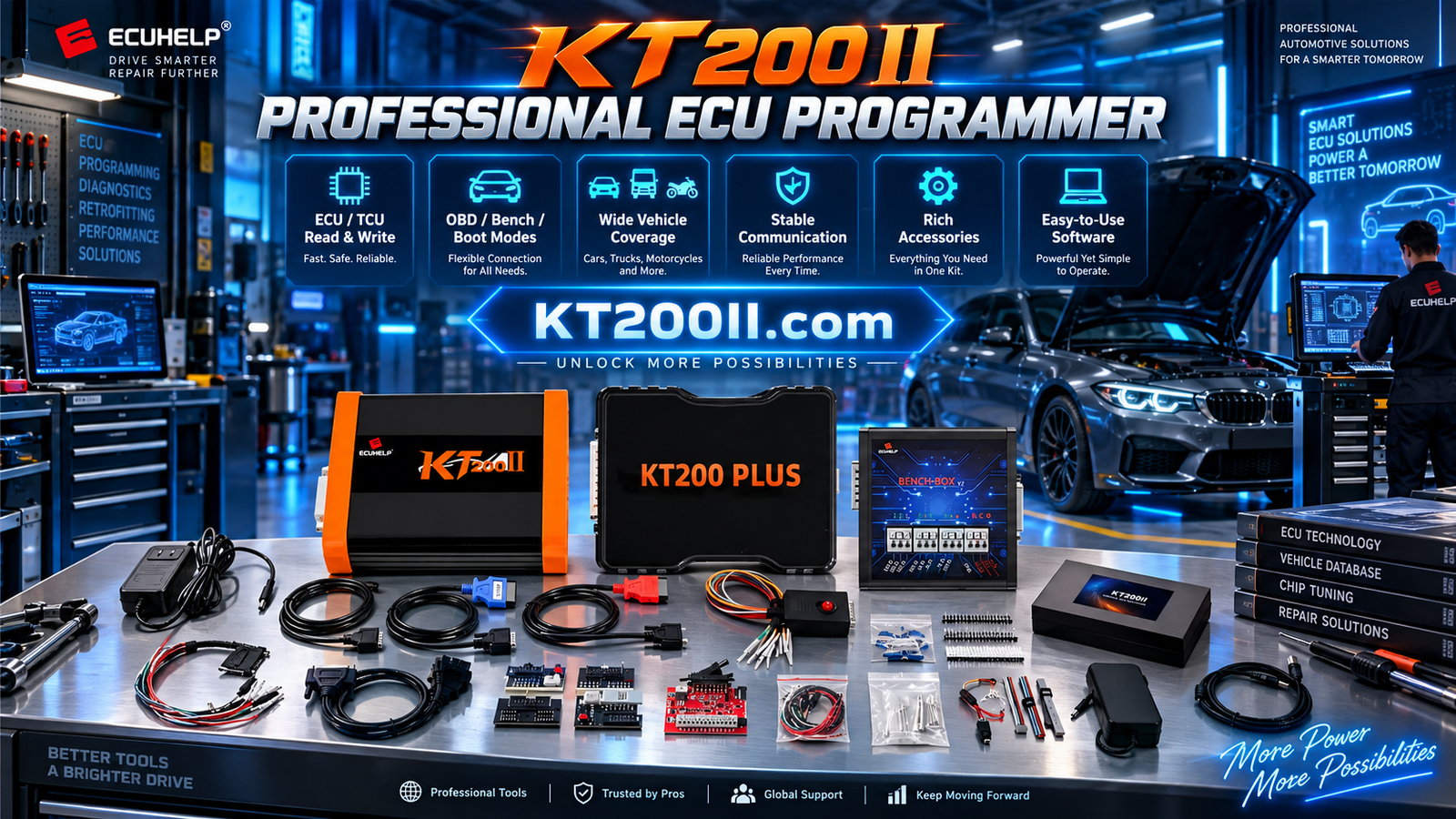
Understanding the difference between Virtual Read and physical ECU read helps technicians select the correct file, preserve suitable recovery data and avoid making incorrect assumptions before writing. For information about supported ECU programming functions and available equipment versions, refer to the official KT200II product page.
What Is a Virtual Read?
A Virtual Read normally retrieves a matching original ECU file from a software database rather than extracting the complete current contents directly from the ECU memory. The programming software identifies the controller and uses details such as its ECU family, hardware reference, software number or calibration version to locate an appropriate file.
This process can be much faster than physically reading a large memory area. It is particularly useful when an ECU protocol supports writing through the diagnostic port but does not offer a conventional physical read of the calibration area.
A Virtual Read file is generally intended to correspond to the identified software version. It should not automatically be treated as a complete backup of everything currently stored inside the ECU.
What Is a Physical ECU Read?
A physical ECU read extracts accessible data from the connected control unit through a supported communication method. Depending on the ECU and protocol, the operation may read flash memory, EEPROM, internal processor memory, external memory or selected calibration areas.
If the ECU currently contains a modified calibration and the selected physical-read protocol accesses that memory area, the resulting file may contain those existing modifications. This differs from a Virtual Read, which generally supplies a matching original file from a database.
The amount of data obtained from a physical read depends on the ECU architecture and selected protocol. An OBD read may provide only the calibration area, while an advanced Boot, JTAG or BDM operation may provide access to additional memory areas. Technicians must check what the selected protocol actually reads instead of assuming that every physical file is a complete backup.
Virtual Read vs Physical Read Comparison
| Comparison | Virtual Read | Physical ECU Read |
|---|---|---|
| File source | Retrieved from a database based on ECU identification | Read from the connected ECU memory |
| Typical speed | Usually fast when a matching file is available | Depends on memory size, protocol and connection mode |
| Existing modifications | Normally provides a matching original file | May contain existing modifications if the relevant area is read |
| Recovery value | Useful for supported calibration work but not always a complete recovery backup | May offer stronger recovery value when all required memory areas are available |
| File availability | Depends on database coverage and exact ECU identification | Depends on whether the selected protocol supports a real read |
| Connection method | Commonly associated with supported OBD workflows | May use OBD, Bench, Boot, JTAG or BDM |
Why Some ECUs Use Virtual Read
Not every ECU allows its calibration data to be physically read through the vehicle diagnostic connector. In some cases, the communication protocol is designed to identify and update the controller but does not provide a conventional read command for the required memory area.
A Virtual Read solves this limitation by identifying the ECU software and supplying a corresponding original file. This can make supported OBD programming faster and more convenient because the ECU may remain installed in the vehicle.
Virtual Read availability still depends on the exact controller and software version. If the database does not contain a suitable file or the ECU identification cannot be confirmed, technicians should not substitute a file based only on a similar filename or vehicle model.
Does Virtual Read Capture an Existing Tune?
Usually, a Virtual Read does not copy the current modified calibration directly from the ECU. It generally supplies an original file selected according to the ECU identification.
This distinction is important when a vehicle may already have been tuned. A technician could receive an original Virtual Read file even though the ECU currently contains modified data. Writing another file without understanding the existing state could remove previous changes or create an unexpected result.
Before working on an unfamiliar vehicle, ask whether the ECU has been programmed previously. Record its identification, perform a diagnostic scan and use a physical-read method when supported and required for the job.
Is a Physical Read Always a Complete Backup?
No. “Physical read” describes where the data came from, but it does not guarantee that every ECU memory area was captured.
A physical OBD read may provide only the calibration section required for routine programming. A Bench protocol may read a different set of data, while Boot, JTAG or BDM access may expose additional flash or EEPROM areas.
Before describing a file as a full backup, confirm:
- Which memory areas were read
- Whether flash and EEPROM are stored separately
- Whether the microcontroller contains additional internal memory
- Whether immobilizer or coding data is included
- Whether the protocol supports restoration or recovery
- Whether the file can be written using the same access mode
The official KT200II operation modes guide explains how OBD, Bench, Boot, JTAG and BDM access differ. The correct method depends on the vehicle, ECU type, processor, protocol and required operation.
When Is Virtual Read Useful?
Virtual Read is useful when the supported protocol identifies the ECU correctly and provides a verified matching original file for calibration programming. Common advantages include:
- Fast access to a matching original calibration file
- No lengthy physical read when the protocol does not provide one
- Convenient OBD programming on supported vehicles
- A clean original starting point for authorized calibration work
- Reduced preparation time for routine supported operations
These advantages do not remove the need for ECU identification, stable vehicle voltage, diagnostic preparation and post-write verification.
When Is a Physical Read More Appropriate?
A physical read may be more appropriate when the technician needs to preserve the data currently stored in the ECU, investigate an earlier modification, prepare for recovery or collect multiple memory areas for an ECU repair or cloning procedure.
Examples include:
- Preserving an existing tuned calibration
- Reading EEPROM data required for a supported service procedure
- Creating a more complete backup before advanced programming
- Comparing the current ECU file with an original reference
- Preparing for ECU cloning or module replacement
- Recovering a controller when normal OBD communication is unavailable
Physical reading should only be attempted with the correct protocol, connection diagram and stable power setup. Boot, JTAG and BDM procedures require additional technical knowledge and careful ECU handling.
Check ECU Support Before Choosing a Read Method
The vehicle model alone does not determine whether Virtual Read, OBD read, Bench read or Boot access is available. Vehicles produced in the same year may contain different ECU hardware or software versions.
Record as much information as possible:
- Vehicle brand, model and production year
- Engine or transmission type
- ECU or TCU manufacturer
- Controller model
- Hardware number
- Software number
- Microcontroller and memory type
- Required read, write, clone or recovery operation
Use the official KT200II supported vehicle and ECU list to search for the exact controller and available connection method. Compatibility should be confirmed before purchasing a tool, opening an ECU or starting a customer job.
Safe File Handling for Virtual and Physical Reads
Virtual and physical files should be clearly separated so another technician does not mistake one for the other. A filename such as “original” is not enough to explain where the data came from.
A practical naming structure can include:
- Vehicle identification
- ECU manufacturer and model
- Hardware and software numbers
- Read method
- Memory area
- Date of the operation
- Original, modified or recovery status
For example, mark the file as “Virtual Read” when it came from a software database. Mark a physical file with the actual connection mode, such as OBD, Bench or Boot. Keep untouched source files separate from working copies and write-ready files.
Verify the File Before Writing
Neither a Virtual Read nor a physical read should be written without verification. Before starting a write operation, confirm the following:
- The ECU identification matches the selected protocol.
- The hardware and software references are compatible with the file.
- The file size and memory area are correct.
- The technician knows whether the file is virtual, physical or reconstructed.
- Required checksum correction has been completed or will be handled by the supported protocol.
- The original data and available recovery files have been stored safely.
- The vehicle or bench power supply is stable.
- The correct cable, adapter and pinout are being used.
If a software-number mismatch, file-length warning or identification conflict appears, stop and investigate it. Do not force an uncertain file into the ECU.
Use Current KT200II Software
Programming protocols, driver packages and compatibility information may be updated over time. Install software from a verified source and follow the current setup instructions.
The official KT200II software download page provides access to the available KT200II software resources. Avoid unknown download packages because unofficial or outdated files may create installation, driver or protocol problems.
Recommended Workshop Workflow
1. Perform a Diagnostic Scan
Record existing diagnostic trouble codes and communication problems before connecting the programming equipment. This separates pre-existing vehicle faults from issues that may appear during the job.
2. Read the ECU Identification
Save the hardware number, software number, calibration reference and any other displayed identification data.
3. Check Official Compatibility Information
Confirm that the exact ECU is supported and identify whether the available method is Virtual Read, physical OBD read, Bench, Boot, JTAG or BDM.
4. Preserve Every Available Original File
If a physical read is available, store all relevant memory areas. If the protocol provides only Virtual Read, label that file accurately and do not represent it as a complete physical backup.
5. Prepare the Write-Ready File
Use a file that matches the identified ECU software. Verify the file size, memory area, modification status and checksum requirements.
6. Stabilize Power
Use an appropriate regulated power supply for vehicle-side or bench programming. Disable computer sleep settings and secure all cables before writing.
7. Follow the Protocol Instructions
Complete every ignition, power-cycle and connection instruction in the correct order. Do not interrupt the software while data is being transferred.
8. Verify the Result
Read the ECU identification again, perform a diagnostic scan and confirm normal operation after programming. Save the final job record with the original and written files.
Common Virtual Read Mistakes
Treating Virtual Read as a Complete ECU Backup
A database file may be suitable for supported calibration programming but may not contain EEPROM, coding, immobilizer or other ECU-specific data.
Assuming the Vehicle Is Completely Original
A Virtual Read may return an original reference even when the ECU installed in the vehicle was previously modified.
Selecting a File by Vehicle Model Alone
The same vehicle model may use several ECU hardware and software versions. Always verify the controller identification.
Confusing File Size with Compatibility
Two files can have the same size but belong to different software versions. Matching file size does not prove compatibility.
Ignoring the Available Recovery Method
Before writing through OBD, determine whether Bench or Boot recovery is supported if communication is interrupted.
Frequently Asked Questions
Is Virtual Read a real read from the ECU?
Virtual Read normally identifies the ECU and retrieves a matching original file from a database. It does not usually extract the current calibration directly from the installed ECU memory.
Will Virtual Read show an existing tuned file?
Normally, no. A Virtual Read generally provides an original file corresponding to the identified software version. A supported physical read may be required to capture the current calibration.
Is every physical read a full backup?
No. The available data depends on the ECU, protocol, memory layout and access mode. Confirm exactly which memory areas were read.
Can a Virtual Read file be used for ECU cloning?
A Virtual Read alone is generally not a complete cloning backup because ECU-specific EEPROM, coding or security data may not be included. Cloning requirements depend on the exact controller.
How do I know which read method my ECU supports?
Search the official support list using the vehicle, engine, ECU model or processor information. Check the listed read, write and connection methods before operating.
Where can technicians find more KT200II technical information?
The official KT200II technical blog contains ECU programming guides, operation-mode explanations, software information and professional workshop recommendations.
Final Summary
Virtual Read and physical ECU read serve different purposes. Virtual Read can provide a fast matching original file for a supported programming protocol, while a physical read captures accessible data from the connected ECU. Neither term automatically means that the file is a complete recovery backup.
Before writing, technicians should identify the exact ECU, check compatibility, understand the source and contents of every file, preserve all available original data and prepare an appropriate recovery plan. For verified product details, operation modes, software downloads, support information and technical articles, use KT200II.com, the official website for the KT200II ECU Programmer.