
ECU Flash vs EEPROM: Understanding Different Memory Areas in ECU Programming
Modern vehicle control units contain multiple types of memory that store software, calibration information and vehicle-specific data.
For professional automotive electronics technicians, understanding the difference between ECU Flash and EEPROM memory is essential for ECU reading, writing, cloning and repair operations.
Although both Flash and EEPROM are non-volatile memory technologies, they have different functions inside an ECU.
What Is ECU Flash Memory?
ECU Flash memory is one of the main storage areas inside many modern vehicle control units.
It usually contains important software and calibration information required for ECU operation.
Flash memory may store:
- ECU operating software
- Control strategies
- Calibration maps
- Engine management parameters
- Transmission control software
During ECU programming, Flash data is often accessed when technicians perform reading, writing, updating or recovery operations.
What Is EEPROM Memory?
EEPROM (Electrically Erasable Programmable Read-Only Memory) is another important memory area used inside many ECUs.
Unlike Flash memory, EEPROM is commonly used for smaller amounts of important configuration and identification data.
EEPROM may store:
- Vehicle configuration information
- Adaptation values
- Module identification data
- Security-related information
- Calibration adjustments
Because EEPROM often contains vehicle-specific information, it can be important during ECU replacement and cloning procedures.
Main Difference Between ECU Flash and EEPROM
| Memory Type | Main Function | Typical Data |
|---|---|---|
| Flash | Stores ECU software and larger data areas | Firmware, calibration maps, control programs |
| EEPROM | Stores configuration and specific vehicle data | Settings, identification information, adaptation data |
Both memory areas may be important depending on the ECU architecture and the required repair operation.
Why Technicians Need to Understand ECU Memory
When performing ECU programming, technicians need to know which memory areas are required for the specific operation.
A complete understanding of ECU memory helps with:
- ECU cloning
- ECU replacement
- ECU backup
- Software recovery
- Electronic repair
Different ECUs have different memory structures, so the required procedure depends on the exact ECU model.
ECU Flash Reading and Writing
Flash reading and writing is one of the most common ECU programming operations.
Technicians may access Flash memory for:
- Original ECU backup
- Software replacement
- Recovery procedures
- Supported calibration operations
Before writing Flash data, professional technicians should always save the original file and verify ECU compatibility.
EEPROM Reading and Writing
EEPROM operations are often related to ECU replacement and cloning procedures.
Depending on the ECU design, technicians may need EEPROM data to transfer important vehicle-specific information to another compatible control unit.
Before any EEPROM operation, creating a backup is an important safety step.
How ECU Programming Tools Access Flash and EEPROM
Different ECUs require different communication methods depending on their architecture.
Common access methods include:
- OBD programming
- Bench programming
- Boot mode programming
- BDM programming
- JTAG programming
The selected method depends on the ECU manufacturer, processor type and supported procedure.
ECU Flash and EEPROM During ECU Cloning
ECU cloning usually requires transferring specific data from an original ECU to a replacement unit.
Depending on the ECU type, technicians may need to transfer:
- Flash memory data
- EEPROM data
- MCU-related information
- Configuration parameters
A correct cloning procedure requires matching hardware compatibility and verifying all required memory areas.
Common ECU Memory Programming Mistakes
Only Backing Up One Memory Area
Some technicians may save only Flash or EEPROM data without confirming whether additional memory areas are required.
The required backup depends on the ECU design and programming method.
Using Incorrect Memory Files
Files must match the correct ECU hardware and software version.
Using incompatible data may result in communication problems or ECU failure.
Interrupting Memory Writing
Power loss or communication interruption during writing can damage ECU data.
Stable power and reliable connections are essential during programming.
Professional ECU Memory Programming Equipment
For technicians working with ECU Flash, EEPROM and advanced programming operations, reliable equipment is essential.
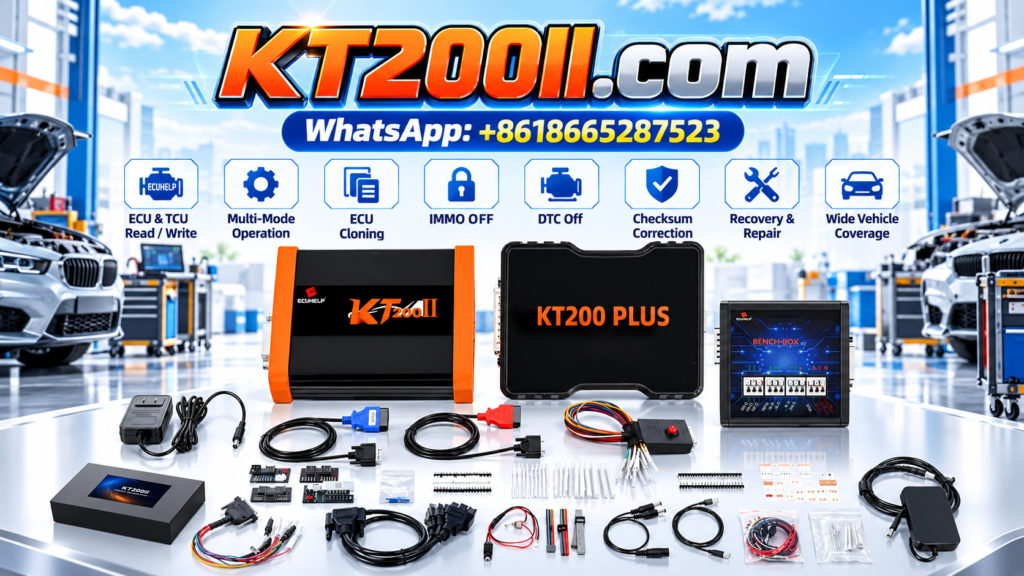
The KT200II ECU Programmer supports professional ECU programming operations on supported applications, including ECU reading, writing, backup and cloning.
Different ECU access methods can be found through:
Check ECU Support Before Programming
Before accessing ECU memory, technicians should confirm vehicle information, ECU type and available programming method.
The official KT200II Support List provides compatibility information for supported ECU applications.
Keep ECU Programming Software Updated
New vehicle platforms continue to introduce updated ECU architectures and memory systems.
Keeping programming software updated helps technicians maintain compatibility with newer applications.
The latest resources are available through:
Conclusion
ECU Flash and EEPROM are two important memory areas used in modern automotive electronics.
Understanding their differences helps technicians perform safer ECU backup, cloning, repair and programming operations.
With correct identification, proper backup procedures and reliable programming equipment, ECU memory operations can become a professional and efficient workshop service.