
CAN Bus Testing Guide: How Technicians Diagnose ECU Communication Problems
Modern vehicles rely on complex electronic networks to allow different control modules to exchange information. Among these systems, CAN Bus has become one of the most important communication networks used in automotive electronics.
For technicians performing ECU diagnostics, repair and programming, understanding CAN Bus testing is essential for identifying communication failures and ensuring successful ECU operations.
What Is CAN Bus?
CAN (Controller Area Network) is a vehicle communication system that allows multiple electronic control units to exchange data through a shared network.
Instead of requiring separate communication wires between every module, CAN Bus allows different control units to communicate efficiently through a common network structure.
Common modules connected through CAN Bus include:
- Engine Control Unit (ECU)
- Transmission Control Unit (TCU)
- ABS Module
- Body Control Module
- Gateway Module
- Instrument Cluster
Why CAN Bus Testing Is Important in ECU Programming
During ECU programming, stable communication between the programming equipment and the control unit is required.
If CAN communication has problems, technicians may experience:
- ECU connection failure
- Programming interruption
- Incorrect module identification
- Communication timeout
- Vehicle network errors
Before replacing equipment or changing software settings, technicians should confirm whether the communication problem comes from the vehicle network, wiring or ECU itself.
Basic CAN Bus Structure
A typical CAN network uses two main communication lines:
- CAN-H (CAN High)
- CAN-L (CAN Low)
These two lines work together to transmit digital communication signals between vehicle modules.
The network also requires:
- Power supply
- Ground connection
- Correct termination resistance
- Proper module communication
Common CAN Bus Communication Problems
1. Open Circuit or Broken Wiring
Damaged CAN wires can interrupt communication between modules.
Possible causes include:
- Damaged harness
- Connector problems
- Corrosion
- Previous repair mistakes
2. CAN-H and CAN-L Wiring Problems
Incorrect CAN-H or CAN-L connections can prevent the ECU from communicating with programming equipment.
Technicians should always verify wiring diagrams before connecting any ECU programming setup.
3. Incorrect Termination Resistance
CAN networks usually use termination resistors to maintain signal stability.
Incorrect resistance values may cause:
- Intermittent communication
- Module dropouts
- Communication errors
4. Faulty Control Module
A damaged ECU or another module on the network can affect overall communication.
A single faulty module may prevent other systems from communicating correctly.
How Technicians Test CAN Bus
Step 1: Visual Inspection
Before using testing equipment, inspect:
- Connectors
- Wiring condition
- Signs of corrosion
- Previous repair work
Many CAN communication problems are caused by physical connection issues.
Step 2: Check CAN Resistance
Measuring resistance between CAN-H and CAN-L can help identify network problems.
An abnormal reading may indicate:
- Missing termination resistor
- Short circuit
- Open circuit
The exact expected value depends on the vehicle system and diagnostic procedure.
Step 3: Check CAN Voltage
Technicians can measure CAN line voltage to confirm whether the network is operating correctly.
Unusual voltage behavior may indicate wiring or module problems.
Step 4: Perform Module Communication Scan
A complete vehicle scan helps determine which modules are communicating and which modules are missing from the network.
This information helps separate ECU problems from wider network issues.
CAN Bus Problems During ECU Programming
During ECU programming, communication failure may not always be caused by the programming tool.
Technicians should check:
- Correct ECU identification
- Correct connection method
- CAN wiring
- Power supply stability
- Programming software settings
A structured troubleshooting process prevents unnecessary equipment replacement.
Relationship Between CAN Communication and Programming Modes
Different ECU access methods may use different communication paths.
| Programming Method | Communication Situation |
|---|---|
| OBD Mode | Uses vehicle diagnostic communication network |
| Bench Mode | Direct ECU communication outside vehicle |
| Boot Mode | Advanced ECU access through specific connections |
Technicians should always select the correct programming method according to the ECU type and supported procedure.
Professional ECU Communication Testing Workflow
A reliable workflow includes:
- Confirm vehicle and ECU information
- Check wiring and connectors
- Verify power supply
- Test CAN communication
- Select correct programming method
- Create ECU backup
- Perform programming operation
- Verify communication after completion
Professional ECU Programming Equipment
Reliable ECU programming equipment should provide stable communication with supported vehicle control units.
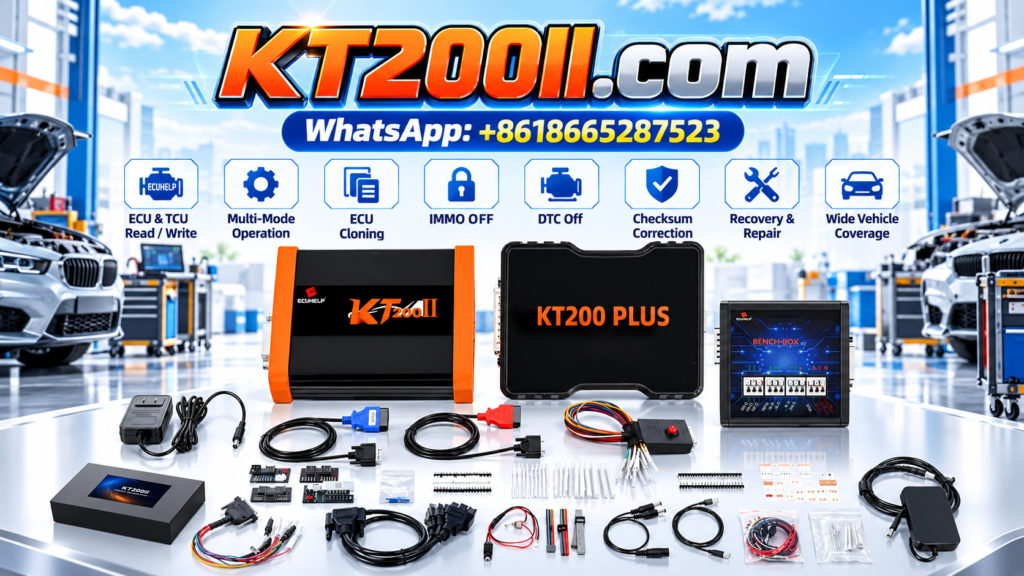
The KT200II ECU Programmer supports professional ECU programming operations including ECU reading, writing, backup and cloning on supported applications.
Technicians can learn more about ECU communication methods and connection procedures through:
Check ECU Support Before Programming
Before performing ECU programming, technicians should confirm:
- Vehicle application
- ECU manufacturer
- Communication protocol
- Required programming method
The official KT200II Support List provides compatibility information for supported ECU applications.
Keep ECU Programming Software Updated
Modern vehicle networks continue to evolve with new ECU generations and communication systems.
Updated software helps technicians maintain compatibility with newer vehicle platforms.
The latest resources are available through:
Conclusion
CAN Bus testing is an important skill for automotive electronics technicians working with ECU programming and repair.
By understanding CAN communication structure, checking wiring, testing network conditions and following a professional workflow, technicians can diagnose ECU communication problems more efficiently.
Reliable communication testing combined with professional ECU programming equipment helps workshops provide safer and more effective electronic repair services.