
KT200II ECU Backup Guide: What Files Should You Save Before Programming?
A successful ECU read does not always equal a complete backup. Before writing, cloning or attempting recovery with KT200II, technicians should understand which identification records and memory areas are available and how each file may be used.
Original ECU data is one of the most valuable assets in an automotive electronics workshop. Programming hardware can be replaced, software can be reinstalled and cables can be repaired, but unique controller data may be difficult or impossible to reconstruct after it has been overwritten.
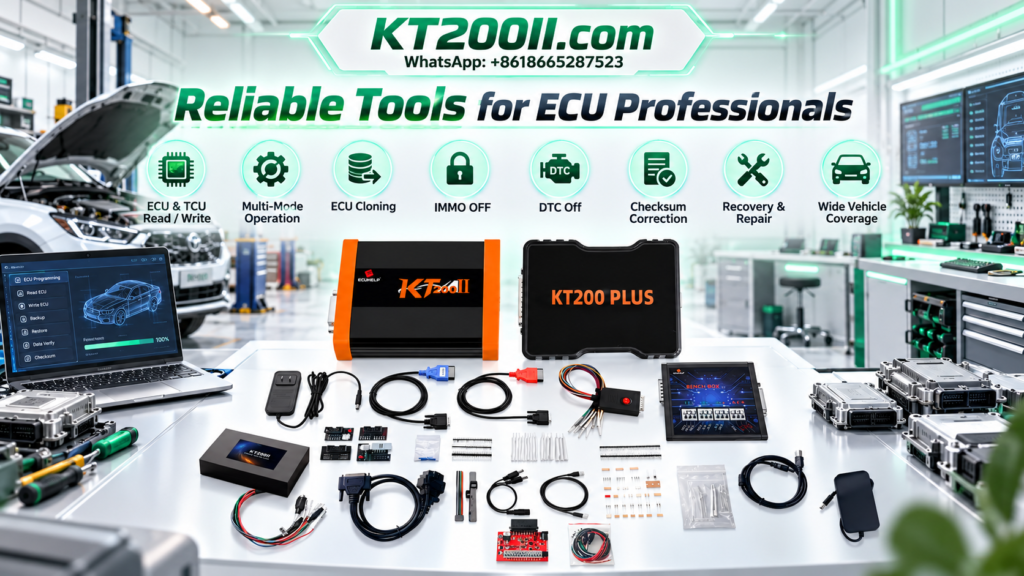
The KT200II ECU Programmer supports identification, reading, writing, backup, cloning and selected recovery operations for compatible ECUs and TCUs. Available functions depend on the exact controller and selected protocol, so a professional backup begins with compatibility checking rather than immediately clicking Read.
Why One Read File May Not Be a Complete Backup
An ECU can contain several memory areas with different purposes. A protocol may provide only a calibration file, while another method may offer Flash, EEPROM, microcontroller data or a complete backup operation.
The file obtained through the easiest connection method is not automatically sufficient for cloning or recovery. For example, an OBD Virtual Read may provide a suitable matched file for a supported writing workflow but may not contain the unique data stored in the physical controller.
Start with Exact ECU Identification
Before reading memory, record the physical and electronic identity of the ECU or TCU. Search the complete controller family in the official KT200II Supported ECU List and compare all available entries.
Save the following information whenever it is available:
- Vehicle manufacturer, model and production year
- Engine or transmission information
- Complete ECU or TCU label photograph
- Controller manufacturer and full family name
- Vehicle manufacturer part number
- Hardware number
- Software number
- Calibration or upgrade number
- Processor or microcontroller type
- Selected KT200II protocol
- OBD, Bench, Boot, JTAG or BDM connection mode
- Communication condition before programming
Take a screenshot of the KT200II identification result and save it in the same folder as the original files. This record can help distinguish similar ECUs and locate a suitable original file if recovery is later required.
KT200II Backup File Types Explained
| Backup Item | Possible Contents | Why It Matters | Main Limitation |
|---|---|---|---|
| ECU Identification | Hardware, software, calibration and protocol information | Supports file matching, protocol confirmation and recovery planning | Identification is not a memory backup |
| Virtual Read | A matching stock or server-supplied file based on ECU identification | May support a defined OBD writing workflow | May not contain current physical data or unique controller information |
| Flash | Operating software and calibration-related data | Important for programming, tuning and software restoration | May not include EEPROM or all processor memory |
| EEPROM | Configuration, adaptation or controller-specific data | Can be important for cloning and controller replacement | Its exact contents vary between ECU families |
| Micro or MCU | Internal processor memory where supported | May be required for deeper backup, cloning or recovery | Not offered by every protocol or connection mode |
| Full Backup | Several required memory areas combined or saved through a dedicated operation | Provides a broader reference for cloning and recovery | The meaning of full backup remains protocol specific |
Virtual Read Is Not the Same as Physical Read
A Virtual Read normally uses ECU identification to obtain a compatible file for a supported programming procedure. It can be efficient because the ECU software does not need to be extracted physically through a long reading process.
A physical read retrieves supported data directly from the connected ECU or TCU. If the controller has previously been modified, the physical read may contain the current calibration rather than an untouched factory file.
Both file types can be useful, but they answer different questions:
- A Virtual Read may provide an appropriate stock reference for the identified software.
- A physical read records the supported data currently stored in the connected controller.
- Neither should automatically be described as a complete cloning file.
- The required file depends on the exact writing, restoration, cloning or recovery operation.
Flash, EEPROM and Micro Data
Flash Memory
Flash commonly stores ECU operating software and calibration data. A Flash read may be the main file used for an authorized calibration workflow, but the exact address range and content depend on the processor and selected protocol.
Two Flash files with the same size are not necessarily interchangeable. Hardware, software, vehicle application, memory layout and checksum requirements must also match.
EEPROM Data
EEPROM may contain configuration and adaptation-related information. In selected ECU or TCU cloning procedures, EEPROM can be as important as Flash because it may contain controller-specific data that is not present in the main software file.
Do not write an EEPROM file from another controller simply because the ECU housings and file sizes appear identical.
Microcontroller Memory
Selected Boot, JTAG or BDM protocols may provide access to internal processor memory. This data can be important for full backup, cloning and advanced recovery, depending on the controller architecture.
Processor-level operations require the correct adapter, circuit-board connection, stable power and exact protocol. Review the KT200II OBD, Bench, Boot, JTAG and BDM guide before choosing a deeper access method.
Professional KT200II Backup Workflow
- Record the complete vehicle history.
Note the vehicle, controller condition, previous programming and required repair operation. - Photograph the ECU or TCU label.
Capture every number clearly before cleaning, opening or connecting the controller. - Check current KT200II support.
Search the exact ECU family and confirm the available identification, read, write, clone and connection functions. - Select the correct programming mode.
Use OBD, Bench, Boot, JTAG or BDM according to the exact protocol and required memory access. - Review the entire connection diagram.
Confirm connector orientation, every positive supply, ground, ignition line and communication connection. - Prepare stable power and communication.
Secure the laptop, USB cable, regulated supply or vehicle battery-support equipment. - Save ECU identification first.
Keep a screenshot and written record of all hardware and software references. - Read every available original memory area.
Save Flash, EEPROM, Micro and full-backup operations where the protocol provides them. - Verify important reads.
When practical, repeat the read and compare the resulting files before relying on the backup. - Protect the master originals.
Create separate working copies and never modify the first verified reads. - Document the write file.
Record whether it is original, modified, virtual, physical, donor or recovery data. - Prepare a recovery path before writing.
Understand which connection and original files would be needed if normal communication were interrupted.
Recommended ECU Job Folder Structure
A consistent folder structure reduces the chance of selecting the wrong file during a busy workshop day. Use a unique job number rather than organizing files only by ECU family.
└── 2026-0087_Vehicle_ECU/
├── 01_ECU_Label_Photos/
├── 02_Vehicle_Information/
├── 03_KT200II_Identification/
├── 04_Connection_Photos/
├── 05_Original_Flash/
├── 06_Original_EEPROM/
├── 07_Original_Micro/
├── 08_Full_Backup/
├── 09_Working_Copies/
├── 10_Write_Files/
└── 11_Operation_Reports/
Include the vehicle, ECU family, hardware number, software number, memory area, read method and date in the filename where practical. Avoid vague names such as original.bin, new.bin or final2.bin when several controllers are being serviced.
How to Verify a KT200II Backup
A file appearing in the folder does not prove that the read was stable or complete. Before programming, check the following:
- The read operation completed without an error
- The file size matches the selected memory operation
- The file is not empty or filled entirely with repeated values
- Repeated reads are identical when stable repeat-reading is appropriate
- The protocol and connection mode have been recorded
- The file belongs to the correct customer job
- The master original has been copied to separate storage
- The file has not been opened and saved by unsuitable software
Backup Requirements for ECU Cloning
ECU cloning involves transferring the necessary data from an original controller to a compatible replacement. A calibration-only Flash file is not automatically enough for this operation.
Before describing a controller as cloneable, confirm:
- The original and donor hardware are compatible
- The required memory areas can be read from the original
- The required memory areas can be written to the donor
- The selected KT200II protocol provides a supported cloning procedure
- Any controller-specific synchronization requirement is understood
- The original ECU data remains protected
Use the KT200II compatibility database to verify the exact controller and available operations instead of assuming that general read and write support guarantees complete cloning.
Backup Preparation Before ECU Recovery
Recovery becomes more difficult when the original identification and memory files were not saved before writing. When a controller loses normal communication, technical support may need the exact protocol, connection mode, original file, written file and failure percentage.
Preserve the following evidence after an interrupted operation:
- Complete error message or screenshot
- Percentage at which the operation stopped
- ECU identification saved before writing
- Original and written filenames
- Selected KT200II protocol
- OBD, Bench, Boot, JTAG or BDM mode
- Voltage and current behavior
- Photograph of the complete connection
- Actions performed after the first failure
Do not repeatedly erase or write different files without understanding the cause. Each additional attempt can overwrite useful data and make a controlled recovery more difficult.
KT200II Pre-Write Backup Checklist
- Exact ECU or TCU identified
- Controller label photographed
- Hardware number recorded
- Software number recorded
- Correct KT200II protocol selected
- Operation mode confirmed
- Connection diagram verified
- Stable power prepared
- ECU identification saved
- Virtual or physical read identified
- Original Flash saved where available
- Original EEPROM saved where available
- Original Micro saved where available
- Full backup saved where available
- Important reads verified
- Master originals protected
- Write file source documented
- File compatibility checked
- Checksum workflow confirmed
- Recovery method considered
Common KT200II Backup Mistakes
Saving Only the Modified File
A modified file cannot replace the untouched original. Preserve the first verified read and work only with duplicate files.
Calling Virtual Read a Full Backup
Virtual Read and physical memory extraction are different processes. Confirm exactly what the selected protocol provides.
Ignoring EEPROM or Micro Operations
When the protocol offers additional memory areas, they may be important for cloning or recovery. Save them before changing the controller.
Using Generic Filenames
Files named read.bin or original.bin can easily be assigned to the wrong vehicle. Use structured job folders and descriptive filenames.
Keeping Only One Copy
A single copy on the laptop is not a secure backup. Maintain a second copy on separate storage.
Assuming a Correct Checksum Proves Compatibility
Checksum validation checks internal file consistency. It does not prove that a file belongs to the connected ECU hardware and software.
Frequently Asked Questions
What should I back up before writing with KT200II?
Save the ECU identification and every original memory operation provided by the exact protocol, including Flash, EEPROM, Micro or full backup where available.
Is a KT200II Virtual Read an original ECU backup?
A Virtual Read may provide a matched file for a supported writing workflow, but it may not contain the current physical data or unique memory from the connected ECU.
Do I need EEPROM for ECU cloning?
Some cloning procedures require EEPROM or other controller-specific memory, while others use a dedicated protocol. Confirm the exact requirements for the ECU and donor controller.
Should I read the same ECU twice?
When the protocol and operation permit repeat reading, comparing two important reads can help confirm connection stability and file consistency.
Where can I download current KT200II software?
Use the installation packages and information provided through the official KT200II Software Download page.
Where can I learn more about KT200II?
Visit the KT200II official website for product information, programming modes, compatibility resources, software and professional ECU guides.
Official KT200II Resources
Use the official KT200II pages to identify the tool, confirm current ECU and TCU support, compare connection modes and prepare the correct software environment.
Final Thoughts
A professional KT200II ECU backup is a documented collection of controller identification, connection information and every relevant memory area provided by the selected protocol. One successful read file should not automatically be treated as a complete backup.
Identify the exact ECU, confirm its current support and choose the correct OBD, Bench, Boot, JTAG or BDM procedure. Save all available original data before writing and protect the master files from modification.
Clear job folders, descriptive filenames, verified reads and separate storage copies make future cloning, restoration and recovery work safer. The few additional minutes spent organizing original ECU data can prevent many hours of difficult recovery later.
Professional and authorized use notice: ECU and TCU identification, reading, writing, cloning, calibration and recovery should only be performed by trained technicians for lawful and authorized vehicle service. Available memory areas and backup functions depend on the exact controller, processor, hardware revision, software version, connection mode and selected KT200II protocol.